
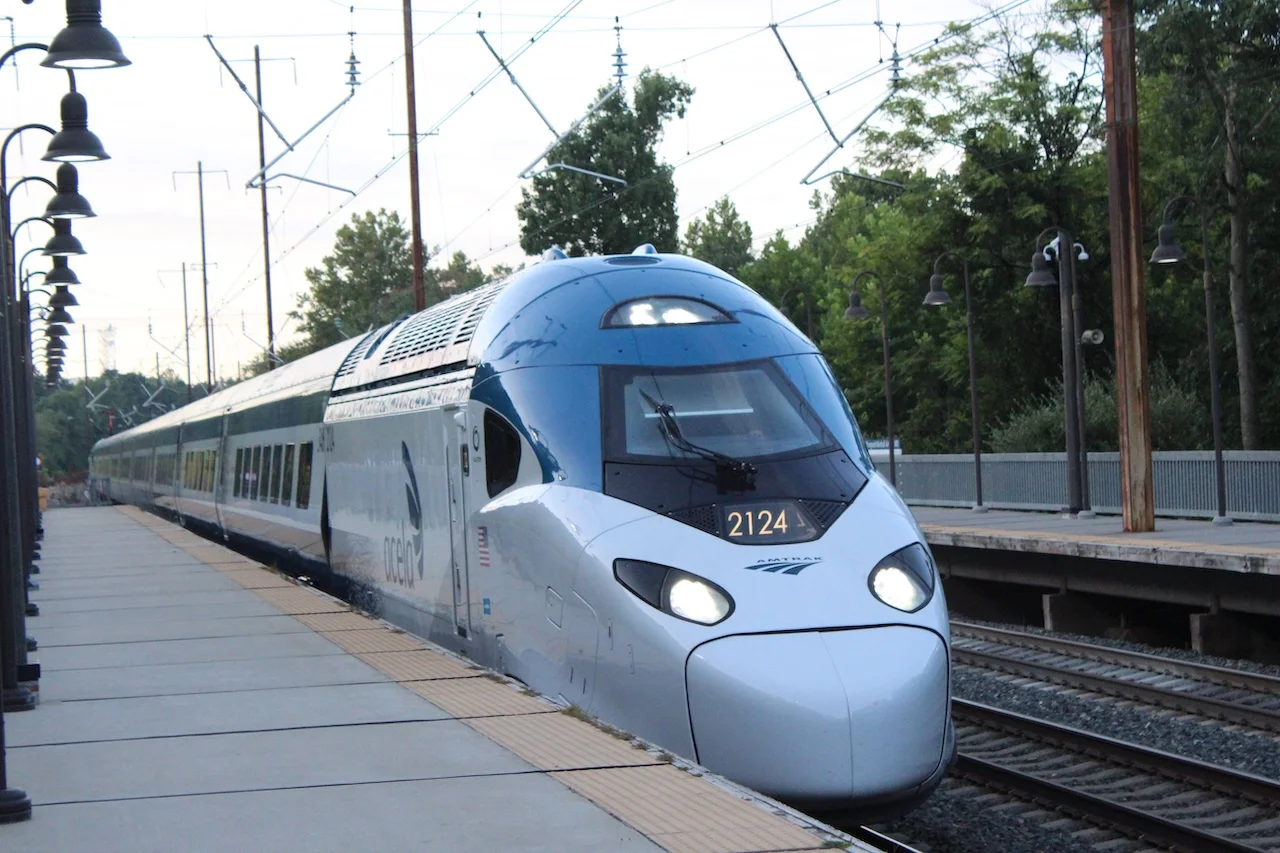
Report outlines 10 areas company can improve acquisition process for Acela, Airo, long-distance equipment
WASHINGTON — With Amtrak currently involved in the three largest equipment acquisitions in its history, the company needs to learn from earlier findings reported by its Office of Inspector General as the procurements are managed, the OIG says in a new report.
That report, released today, offers 10 areas in which improved planning, coordination and oversight could better manage costs, schedule, and performance as the company addresses the NextGen Acela, Airo, and new long-distance fleet acquisitions. It draws on 13 years of prior reports from the Amtrak OIG, as well as industry and government best practices.
In a memo to Amtrak President Roger Harris accompanying the report, Inspector General Kevin Winters says incorporating these lessons “would not only assist the company’s current acquisition portfolio but also preserve more than a decade’s worth of institutional knowledge for future rolling stock replenishments.”
The lessons are spread across what the report characterizes as six phases of acquisition, from strategic planning to benefit realization once acquisition is complete. They include:
Align the program with company goals. This includes ensuring the acquisitions match such goals as the number and frequency of trains it plans to operate and its ridership and revenue targets. The report references the planning misalignment between acquisition of the NextGen Acela and Airo trainsets and the maintenance facilities to support them, with planning for the latter about 15 years behind that of the trainsets. As a result, it may not initially be able to make full use of the Acela and Airo equipment once it all has been delivered.
Develop a business justification before initiating a rolling-stock acquisition. Such justification should explain why the new equipment is necessary, weigh options including a “do nothing” or “base case” alternative, and assess total costs of ownership. This draws on lessons from a 2014 report that found that the preliminary business case for the NextGen Acela trainsets did not fully explain some of its assertions, projected revenue through 2045 but ridership only through 2030, and based projected maintenance costs on comparisons with foreign railroads, which may have understated the true expenses.
Engage stakeholders early and throughout the process. Such communication can avoid later cost increases and schedule delays. In development of the Airo trainsets, late feedback led to changes in the café cars that required a $42.5 million change order and delayed initial delivery by more than five months.
Develop realistic and feasible requirements. “Although novel designs and amenities may initially be appealing,” the report says, “they are inherently risk-prone and slower to develop than designs and improvements that are tested and proven.” More complex features and amenities could be considered later as contract options. Examples include the fact that the NextGen Acelas went into mass production before determining if the new designs met safety standards, leading to multi-year delays, and the company’s design requirements for a new generation of bi-level equipment which were rejected by potential builders, ultimately leading that project to be dropped in place of a universal single-level procurement.
Establish a comprehensive management framework. Such a framework gives Amtrak the management and tools to address activities which are often occurring concurrently. The report notes Amtrak has strengthened such programs in recent years through such moves as creating a department to lead major capital programs and improving schedule management on the Airo program. It includes clearly defining the roles of those involved in the acquisition, establishing clear lines of authority, and developing a risk management plan and schedule management. The latter two areas proved to be issues in the NextGen Acela program, the OIG found in earlier reports.
Establish specific, measurable performance standards. This can help builders meet company requirements, which in turn is tied to meeting delivery and operation timelines. As mentioned above, the NextGen Acela went into production before computer modeling was completed that showed the train would meet Federal Railroad Administration safety standards, as the contract did not require the builder to do so. This inability to meet the modeling standard was a primary factor in the four-year delay in NextGen Acela delivery.
Perform rigorous oversight of the quality and functionality of the new equipment before accepting it. Quality control should start at the beginning of production, the report says, and continue through service launch. The OIG has previously found that Amtrak did not fully enforce the quality standards in the NextGen Acela contract in an effort to receive the new equipment faster, leading to issues in revenue service including malfunctioning bathrooms, faulty communication systems, and mechanical issues. The Acelas are not yet using the tiling system designed to improve trip times and ride quality, and as a result are not meeting the speeds and trip time specified in the contract. Also, on at least two occasions, exterior panels have come loose and contacted a third rail, causing significant damage. One of those led to a May fire near New York Penn Station that caused major service disruptions [see “Most commuter service …,” Trains.com, May 15, 2026].
Assess the longevity and utility of existing rolling stock as part of an asset lifecycle management process. Regular assessments of the condition of equipment, including its structural integrity, can ensure planning allows the manufacturer to deliver new rolling stock before legacy equipment reaches the end of its service life, allows Amtrak to plan for decommissioning equipment, and improve equipment reliability and avoid sudden removal of equipment no longer fit for service. The 2025 removal of the Horizon fleet from service came when mechanical department personnel found significant corrosion on some cars; department officials told the OIG there had been no comprehensive assessments of rolling stock before that point.
Maximize the use of maintenance and parts contracts. Amtrak plans to sign a Technical Support and Spares Supply Agreement on each of the current acquisitions to provide access to outside expertise as well as parts that could be more costly for the company to buy and manage. [It is under such a contract that Alstom is building a new facility in Delaware for NextGen Acela maintenance; see “Alstom to build …,” June 5, 2026]. The company did not effectively use its contract for the legacy Acelas, the OIG found. As a result, it did not assess up to $19 million in penalties for late delivery and accumulated more than $18 million in outstanding warranty claims, which took at least two years to settle and collect.
Capture and implement any additional lessons learned. This would require regular assessments through the life of an acquisition, the report says, and using those to create processes that can be used in future acquisitions. “This report — and the company’s nascent actions at collecting such lessons — could provide a useful starting point, the OIG says. It cites a 2023 OIG report that found that the company had not made such assessments; Amtrak responded with policies and procedures to catalogue such findings and make them available for all Capital Delivery program teams.
The full OIG report is available here. Trains has asked Amtrak if it has any comment on the report and will update this article with any response.